
A Complete Guide to RAG Pipelines in 2026

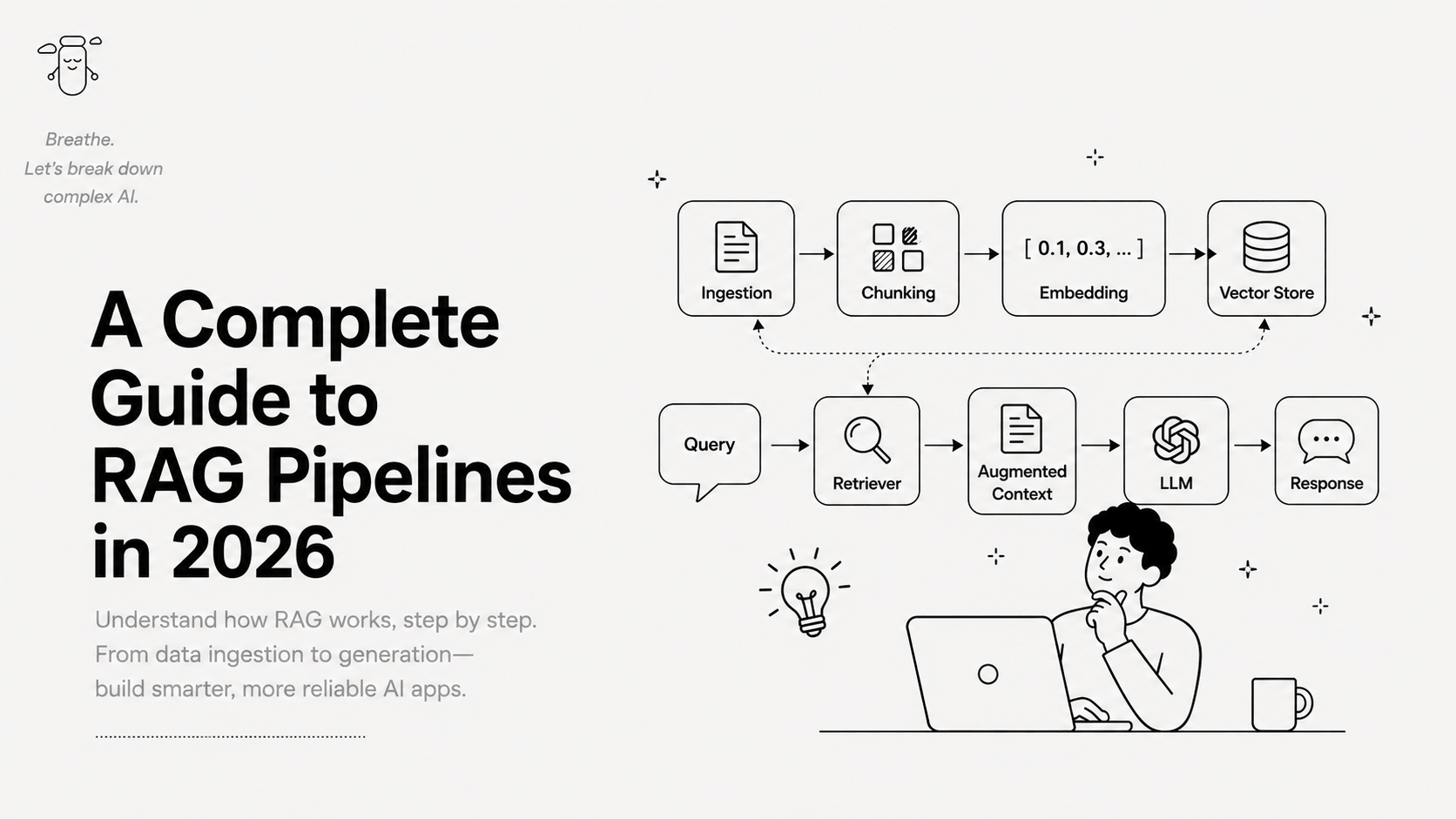
TL;DR: LLMs hallucinate or don’t always return correct information because they're stuck in the past. RAG pipelines fix that by connecting them to real, up-to-date knowledge before generating a response, turning unreliable AI into a trustworthy one.
Key Takeaways:
- A RAG pipeline has two phases: offline indexing (chunk → embed → store) and online querying (retrieve → augment → generate)
- Chunking strategy is the most underrated decision — bad chunks poison everything downstream
- Your vector database choice determines speed, scale, and cost at production
- Hybrid search (semantic + keyword) consistently outperforms either method alone
- Re-ranking after retrieval dramatically improves what the LLM actually sees
- LangChain for complex workflows, LlamaIndex for fast retrieval, Haystack for enterprise production
- Production RAG costs $350–$2,850/month depending on scale, can be a lot cheaper but the most reliable sit in that range.
- RAG is for dynamic knowledge; fine-tuning is for consistent behaviour and tone
- Garbage in, garbage out, the indexing phase is where most RAG systems fail silently
- Chunk size sweet spot: 300–500 tokens for most use cases
- Every pipeline stage compounds, weak retrieval can't be saved by a better LLM
- A RAG pipeline without observability is just a demo
What Are RAG Pipelines
Large Language Models have revolutionised how we interact with AI, but they come with a critical limitation: they can only draw from the data they were trained on. When you ask an LLM about recent events, proprietary company data, or specialized knowledge outside its training set, it often generates plausible-sounding but incorrect information—a phenomenon known as hallucination. Retrieval-Augmented Generation (RAG) pipelines solve this problem by connecting LLMs to external, authoritative knowledge bases, enabling them to access current, factual information before generating responses.
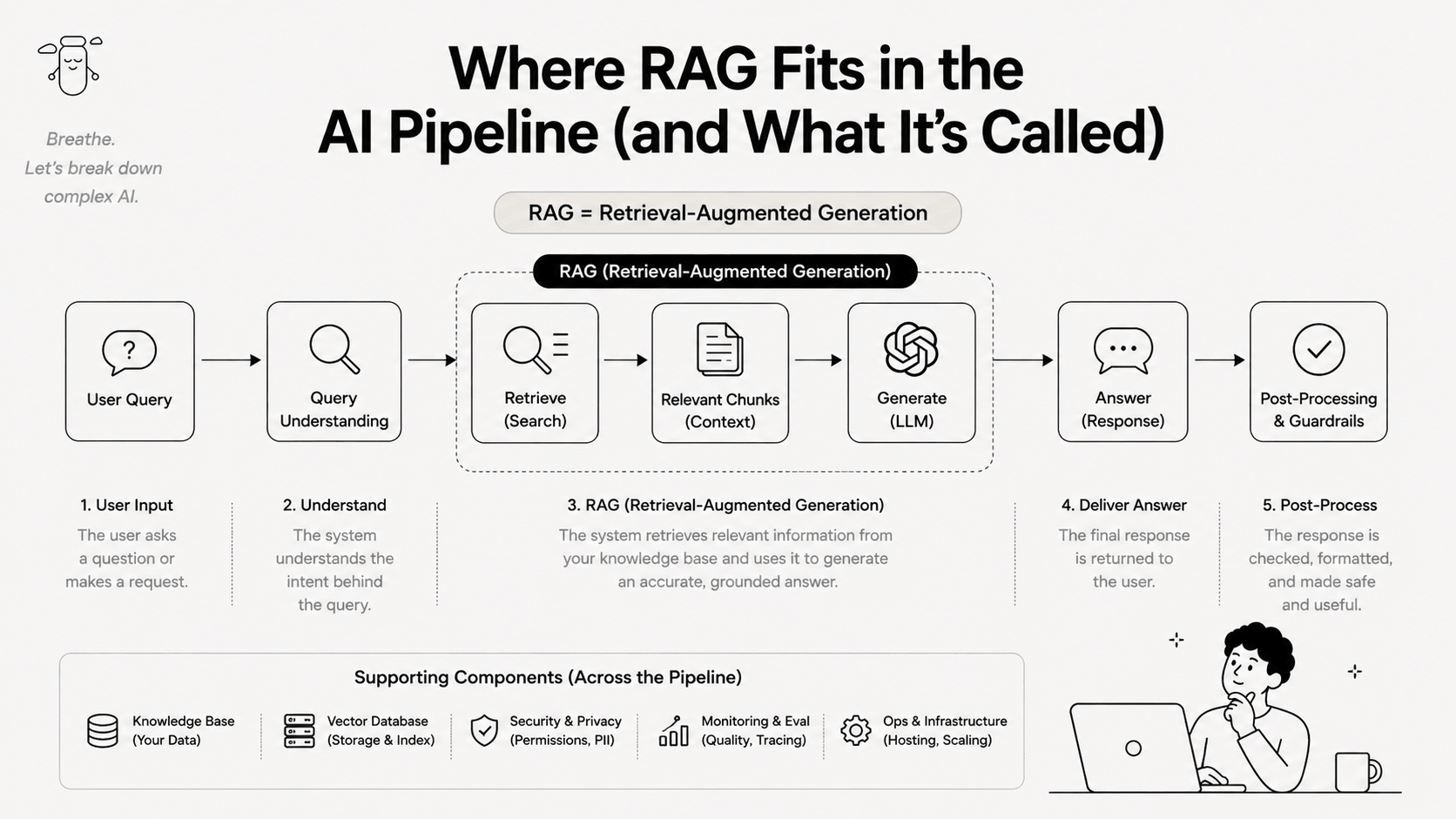
A RAG pipeline consists of two core components working in tandem: a retriever model that fetches pertinent documents and a generator model (the LLM) that synthesizes answers based on retrieved context. This architecture addresses two fundamental challenges plaguing standalone LLMs. First, LLMs can generate incorrect but persuasive answers when their training data is inaccurate or incomplete. Second, their training data becomes outdated over time, leading to responses that don't reflect current information. By grounding responses in real-time data retrieval, RAG pipelines dramatically reduce hallucinations and ensure accuracy.
The magic of RAG lies in how it bridges static and dynamic knowledge. While LLMs are trained on fixed datasets, RAG pipelines integrate them with real-time internal data, allowing organizations to leverage powerful language models without the prohibitive cost of constant retraining. This happens through two distinct phases: the indexing phase, where documents are chunked, converted into vector embeddings, and stored in a searchable database, and the retrieval-generation phase, where user queries are embedded, relevant documents are retrieved, and augmented into prompts sent to the LLM.
Real-world applications demonstrate RAG's transformative potential. Organizations deploy chatbots that extract precise answers from corporate documentation for automated customer support, while employees access internal company data for HR policies, compliance, and security questions. Unlike standard LLMs that provide identical responses to everyone, RAG systems deliver role-specific and secure responses based on user permissions. Perhaps most importantly, RAG pipelines enhance explainability by pointing to their data sources, building trust through transparency—a critical requirement for enterprise AI adoption.
How RAG Pipelines Work
Understanding the inner workings of a RAG pipeline is essential for implementing effective retrieval-augmented generation systems. At its core, a RAG pipeline follows a sequential flow: Ingest, Index, Retrieve, Augment, and Respond, combining both offline data preparation and online query processing to deliver accurate, context-aware responses.
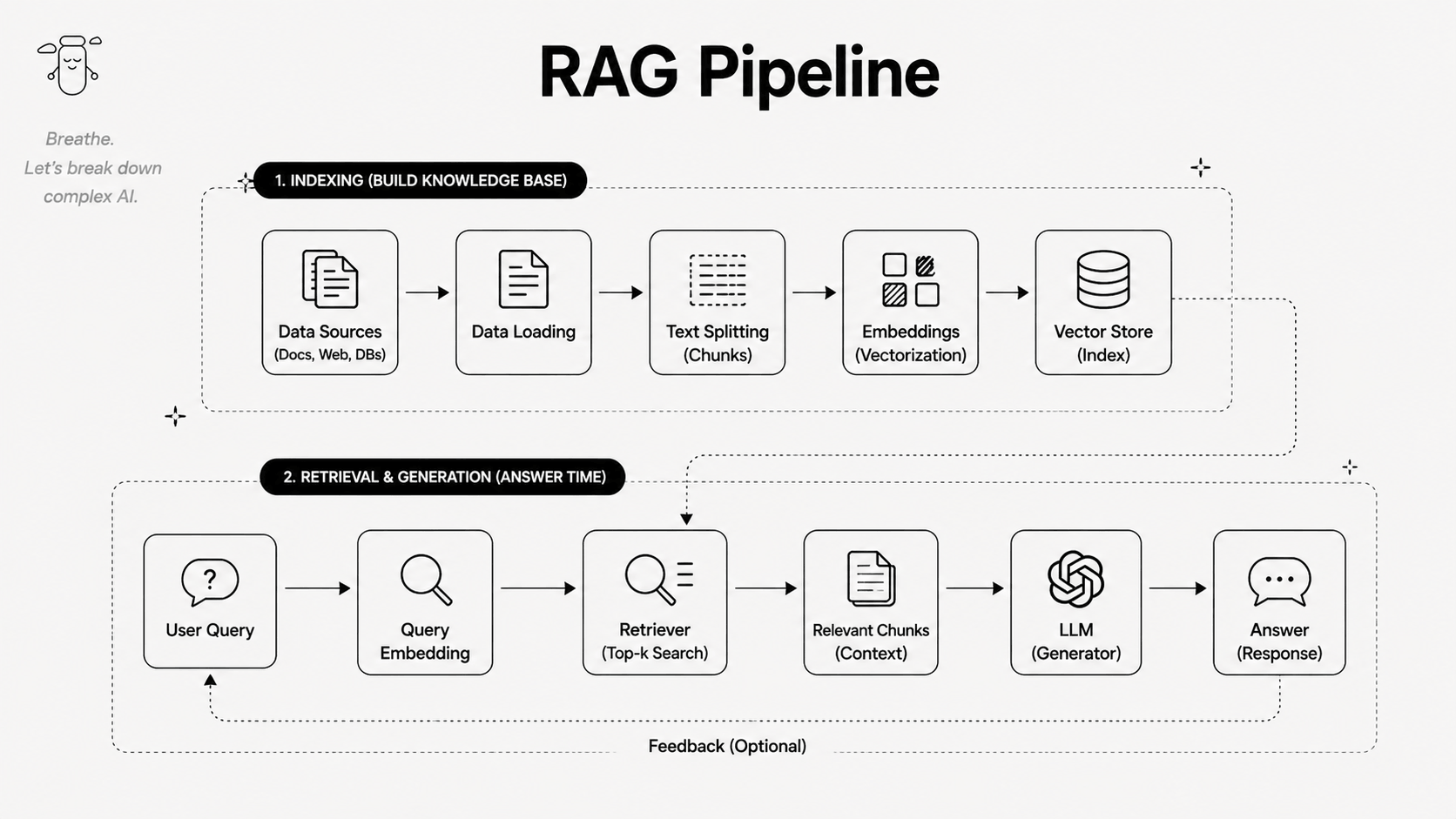
The complete RAG pipeline workflow showing the interaction between indexing, retrieval, and generation phases.
The Indexing Phase: Preparing Your Knowledge Base
The indexing phase is a critical offline process where source documents are transformed into searchable knowledge. This begins with data ingestion, which involves gathering raw material from various sources like cloud drives, Notion, and web archives, then parsing them into structured elements.
Document Chunking is the next crucial step. Documents are divided into smaller, manageable segments, typically between 200-500 tokens, because large documents reduce retrieval precision. Effective chunking strategies include:
- Semantic chunking: Respects logical boundaries like paragraphs and section headers
- Overlapping chunks: Preserves context across segment boundaries
- Fixed-length chunking: Maintains consistent token counts
Following chunking, each segment is converted into a numerical representation called an embedding vector by an embedding model. These vectors capture the semantic essence of the text, enabling similarity-based searches that go beyond simple keyword matching.
Finally, chunks and their embeddings are stored in a vector database along with key metadata like stable IDs, source pointers, timestamps, and access attributes. This metadata enables content management, auditing, and access control while incremental sync mechanisms keep the index aligned with changing data.
The Retrieval Phase: Finding Relevant Context
When a user submits a query, the retrieval phase springs into action. The user's query is embedded using the same embedding model used during indexing, then used to search the vector database for semantically similar chunks.
Modern RAG systems often employ hybrid search approaches that combine dense vector (semantic) search with sparse vector (lexical) search like BM25 to improve accuracy and coverage. Metadata filters can further refine results by date, user permissions, or document type, ensuring the most relevant context is retrieved.
The Generation Phase: Augmented Response Creation
In the generation phase, retrieved chunks are assembled into a concise context block and merged with the original user query to form an augmented prompt. This augmented prompt provides the LLM with both the user's intent and necessary external knowledge.
The LLM then synthesizes this information, drawing from both the augmented prompt and its internal training data, to generate a final response. This process ensures outputs are more factually accurate, relevant, and grounded in the provided context. Generation parameters like model choice, temperature settings, and output validation are managed at this stage to optimize response quality.
The Complete Pipeline in Action
A RAG pipeline functions as a relay race where each component passes information to the next. The process distinguishes between two critical workflows:
Offline RAG Data Pipeline:
- Data connectors gather raw information
- Parsing structures the content
- Chunking divides documents appropriately
- Embedding creates vector representations
- Vector database stores indexed content
Online RAG Query Pipeline:
- Query embedding converts user input
- Retrieval mechanism searches for relevant chunks
- Augmentation combines context with the query
- Generation produces the final response
The interaction between these components—how they pass information, recover from errors, and adapt to new data—defines the system's behavior. This end-to-end processing chain ensures that ingested documents are properly prepared and utilized, preventing issues like token waste and inaccurate information that arise from incomplete implementation.
💡 Key Insight: The quality of each pipeline stage directly impacts the final output. Poor chunking leads to fragmented context, inadequate retrieval misses relevant information, and weak augmentation produces generic responses.
Core Components of RAG Pipelines
Building on the RAG workflow discussed earlier, let's examine the individual building blocks that power these intelligent systems. Each component plays a specialised role in transforming raw data into contextually accurate AI responses.
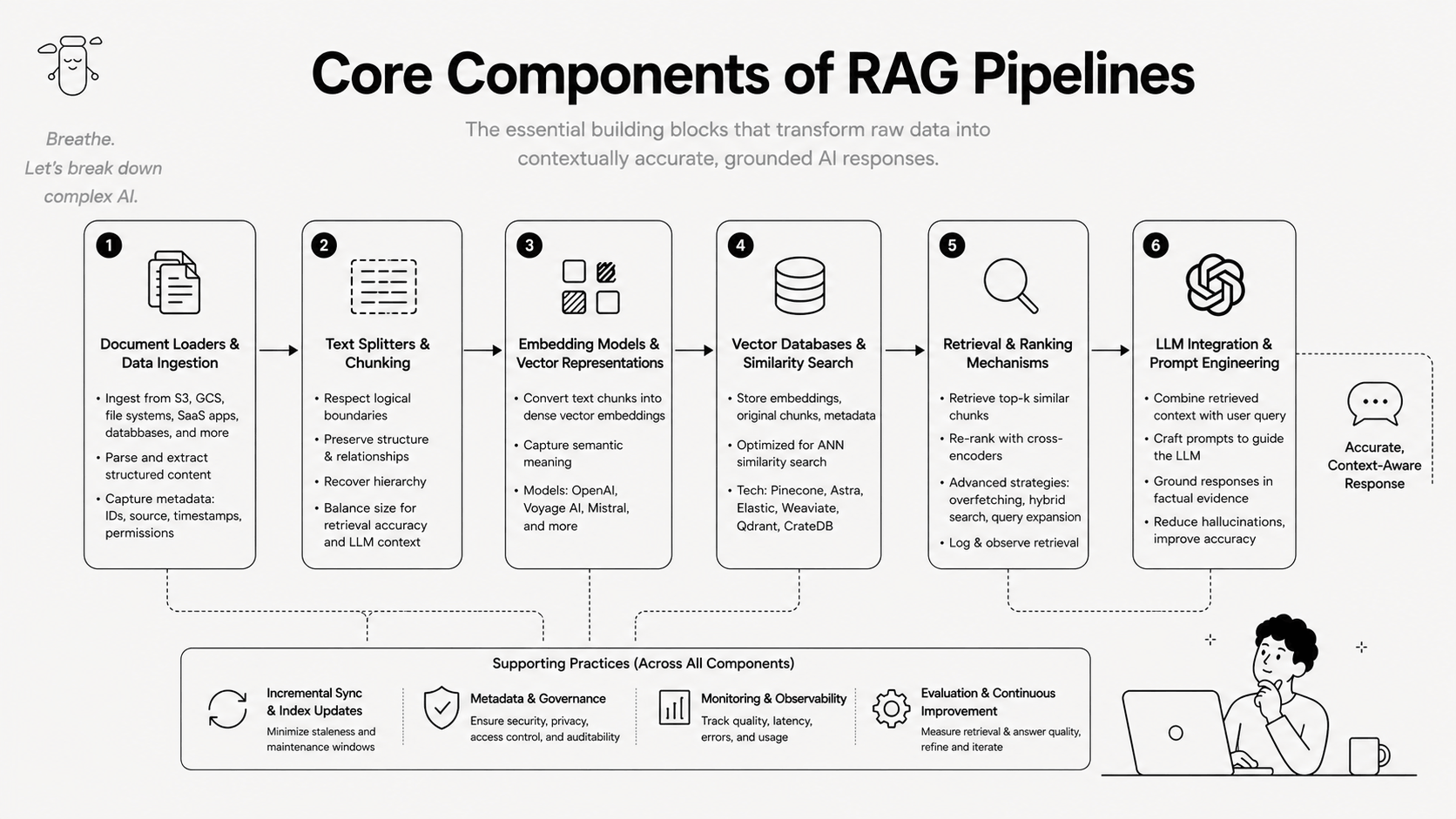
Document Loaders and Data Ingestion Systems
The foundation of any RAG pipeline begins with source connectors that pull information from diverse locations like Amazon S3 buckets, Google Cloud Storage, file systems, and SaaS platforms. Frameworks like LangChain and LlamaIndex offer document loaders to handle data from sources including Confluence, CSV files, and Outlook emails.
The ingestion process does more than simply move files—it must parse raw files into structured elements, as errors in this stage can lead to incorrect meaning being encoded later. For production systems, maintaining metadata such as stable IDs, source pointers, timestamps, and access attributes is essential for governance and auditing.
💡 Best Practice: Implement incremental sync rather than full rebuilds for index refreshes to minimize staleness and reduce maintenance windows.
Text Splitters and Chunking Strategies
After ingestion, documents must be divided into manageable fragments through chunking. This seemingly simple step significantly impacts pipeline performance. Overly large chunks can exceed an LLM's context window, while excessively small chunks may lack sufficient relevant information.
Blind, fixed-length chunking can separate related elements like tables from their labels or code blocks from comments, leading to orphaned fragments that can be misinterpreted. Effective chunking strategies:
- Respect logical boundaries rather than cutting by arbitrary character counts
- Preserve document structure to maintain context and relationships
- Recover hierarchy to assemble context-aware chunks
- Balance size to optimize for both retrieval accuracy and LLM processing
Embedding Models and Vector Representations
Vectorization transforms text chunks into numerical vector embeddings that capture the semantic meaning of the data, enabling contextualized searching beyond simple keyword matching. The choice of embedding model directly influences retrieval quality—models from OpenAI, Voyage AI, and Mistral each offer different trade-offs in accuracy, speed, and cost.
These embeddings convert human language into mathematical representations where semantically similar concepts cluster together in high-dimensional space, allowing machines to understand meaning rather than just matching words.
Vector Databases and Similarity Search Engines
Vector databases are specialized systems optimized for efficiently handling and searching high-dimensional vectors using approximate nearest neighbor (ANN) algorithms. Unlike traditional databases that index text or numbers, they excel at finding semantically similar content.
Popular vector database technologies include Pinecone, DataStax Astra, Elastic, CrateDB, Weaviate, and Qdrant. When selecting a vector database, consider:
Criterion | Importance |
|---|---|
Speed | Low latency for real-time responses |
Scalability | Handle growth from thousands to millions of vectors |
Integration | Clean APIs and SDK support |
Cost | Balance managed services with open-source options |
Retrieval Mechanisms and Ranking Algorithms
When users submit queries, the retrieval process fetches candidate chunks based on semantic similarity. However, raw retrieval results require refinement. Ranking and re-ranking mechanisms employ sophisticated models, often cross-encoders, to reorder retrieved chunks and prioritize the most pertinent information.
Advanced retrieval strategies include:
- Overfetching: Retrieve more candidates than needed, then filter
- Hybrid search: Combine dense and sparse retrieval methods to improve recall
- Query expansion: Reformulate queries to capture more relevant results
- Observable retrieval: Log queries and retrieved chunks to distinguish retrieval failures from generation failures
LLM Integration and Prompt Engineering
The final component brings everything together. Retrieved context is combined with the user's original query to form an enhanced prompt that is fed to language models like OpenAI or LLaMA. RAG prompt engineering guides the LLM on how to utilize the retrieved data, focusing on pertinent details and specifying the desired tone.
This methodology helps mitigate LLM limitations such as AI hallucinations by grounding responses in factual, retrieved evidence, ensuring outputs are accurate and verifiable rather than fabricated.
How Each Component Contributes to Pipeline Performance
Every component in the RAG pipeline forms a critical link in the chain of accuracy and reliability. Document loaders establish the knowledge foundation, while chunking strategies determine whether information remains coherent or becomes fragmented. Embedding quality dictates retrieval precision, and vector databases provide the speed necessary for real-time applications.
Retrieval mechanisms and ranking algorithms determine how well the system filters noise and surfaces the most pertinent information, directly influencing answer quality. Finally, prompt engineering ensures the LLM effectively leverages retrieved context to generate responses that are accurate, reliable, and contextually appropriate.
⚠️ Critical Insight: A RAG pipeline without proper orchestration is merely a demo—with orchestration, it becomes a production system capable of handling real-world complexity and scale.
Document Processing and Chunking Strategies
Building on the core components discussed earlier, document processing and chunking represent the critical foundation that determines your RAG pipeline's effectiveness. While we've covered the high-level architecture, this section explores the technical nuances of preparing documents for optimal retrieval performance.
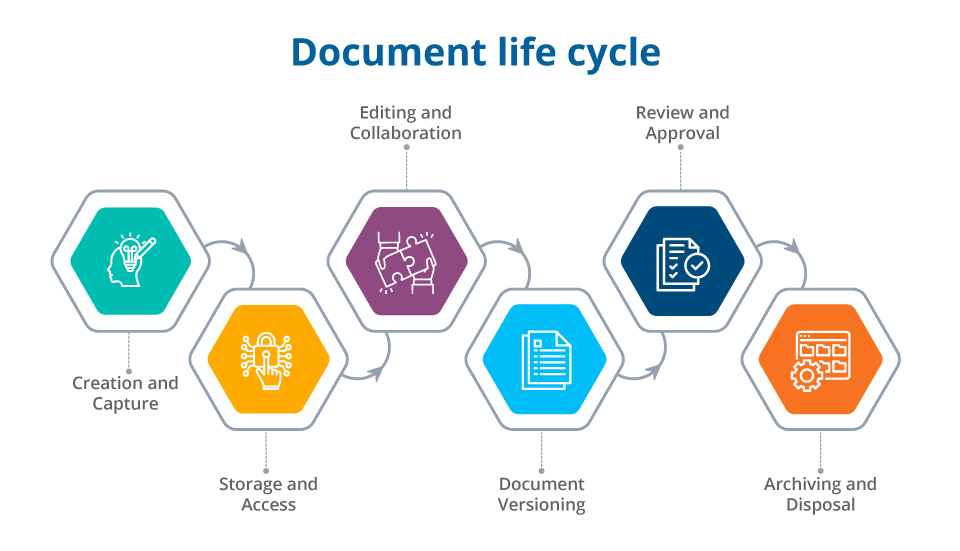
The document lifecycle in RAG systems requires careful processing at each stage to maintain information integrity.
Why Document Preprocessing Matters
Preprocessing aims to make data "RAG-ready" by removing non-informative characters while preserving essential information. This involves stripping format-specific elements like excessive whitespace, blank lines, and irrelevant patterns that carry no semantic value. However, the key is strategic preservation: some stripped data can be converted into metadata to retain important structural information about the document's organization and hierarchy.
Poor preprocessing leads to noisy embeddings, irrelevant retrievals, and degraded LLM responses. Clean, well-structured data ensures your vector representations accurately capture semantic meaning.
Chunking Strategies Explained
Selecting the right chunking approach directly impacts retrieval precision and context preservation:
Fixed-Size Chunking remains the simplest method, dividing text into equally sized segments based on character, token, or word counts. It offers predictable chunk counts and straightforward implementation, making it ideal for homogeneous text. The downside? It can arbitrarily split sentences or concepts mid-thought, fragmenting semantic units.
Recursive Chunking takes a hierarchical approach, first dividing content based on structural cues like paragraphs or line breaks, then recursively splitting sections that remain too long. This method respects document structure better than fixed-size chunking but still lacks semantic awareness.
Semantic Chunking represents the most sophisticated strategy, using embeddings to detect shifts in meaning and grouping semantically related sentences together. This approach creates coherent, self-contained chunks that preserve context and improve both retrieval precision and recall, particularly for structured documents.
Syntax-Based Chunking leverages natural language boundaries, breaking documents into sentences using libraries like spaCy or NLTK. It can also respect file format-specific divisions, such as code functions or HTML table structures.
Optimal Chunk Size: Finding the Balance
Chunk size impacts LLM context window limits and information relevance. Too large, and you exceed model constraints or dilute relevant information; too small, and you lose necessary context.
Recommended chunk sizes:
- 100-256 tokens: Ideal for high-precision recall in semantic search
- 300-500 tokens: General-purpose sweet spot for most RAG applications
- 1024+ tokens: Used when providing complete context to LLMs with larger windows
💡 Key Insight: Smaller chunks are often more manageable for models with limited context windows, but experimentation with your specific data and use case is essential.
The trade-off is clear: fixed-size chunking offers speed and simplicity but fragments information, while semantic strategies provide contextually relevant results at the cost of computational overhead and variable chunk sizes.
Handling Diverse Document Types
Different formats demand specialized processing approaches:
Tables: Avoid using tables directly; instead, reformat table information into multi-level bulleted lists or flat-level syntax, which LLMs digest more easily. Flat-level syntax presents information at the same hierarchical level, improving coherence.
Code Files: Chunk and vectorize code as whole functions or classes to maintain integrity, preventing broken logic across chunk boundaries.
PDFs and HTML: Preserve structural elements like <table> or <img> tags, using specialized parsers that understand format-specific nuances.
Images and Graphics: For multi-modal LLMs, reduce image resolution, remove redundant visuals, and add textual descriptions to improve accessibility and context.
Metadata Extraction and Enrichment
Metadata provides context, improves filtering, and enhances retrieval accuracy by offering additional signals about document content and structure.
Essential metadata types:
Category | Examples |
|---|---|
Document-level | File name, URLs, author, timestamps, versioning |
Content-based | Keywords, summaries, topics, named entities, domain tags |
Structural | Section headers, page numbers, semantic boundaries |
Contextual | Source system, ingestion date, data sensitivity, language |
Storing metadata alongside chunks or embeddings enables hybrid search, combining vector similarity with keyword filtering for superior retrieval. Tools like Unstructured.io, LangChain, and LlamaIndex offer built-in parsers and automation for metadata extraction.
Overlap Strategies for Context Preservation
Overlap between consecutive chunks helps maintain context across boundaries, preventing information loss when ideas span multiple chunks.
Best practices:
- Adopt 10-20% overlap for recursive and semantic chunkers
- Fixed-size chunking often uses explicit overlap (e.g., 200 tokens with 1000-token chunks)
- Balance redundancy against context preservation to avoid excessive processing costs
⚠️ Warning: Too much overlap increases storage and computational costs; too little creates contextual gaps that degrade retrieval quality.
Best Practices for Document Preparation
Optimize your RAG pipeline with these proven strategies:
- Structure with Clear Headings: Properly organizing content with headings and subheadings improves readability and helps RAG models understand document structure
- Preserve Logical Boundaries: Choose parsers that respect document structure, chunking along sections and paragraphs rather than arbitrary character counts
- Maintain Sequential Clarity: Ensure numbered lists are sequential and add transitions between items to guide the LLM through content flow
- Integrate Metadata Strategically: Store metadata alongside embeddings to enable filtering and hybrid search capabilities
- Experiment and Iterate: Select chunking strategies and sizes based on your specific data, model constraints, and token pricing, then test and refine
- Clean Systematically: Strip unnecessary characters while converting valuable structural information into metadata
The document processing stage sets the foundation for everything downstream in your RAG pipeline. Invest time in thoughtful preprocessing, strategic chunking, and comprehensive metadata extraction to unlock superior retrieval performance and more accurate LLM responses.
Vector Embeddings and Semantic Search
Once your documents are properly chunked and prepared, the next critical step in building an effective RAG pipeline is transforming that text into a format that machines can understand semantically. This is where vector embeddings come into play, serving as the bridge between human language and mathematical representations that enable intelligent retrieval.

Vector embeddings transform text into numerical representations in high-dimensional space, enabling semantic similarity comparisons.
What Are Vector Embeddings?
Vector embeddings are numerical representations that capture the semantic meaning and relationships within data. Rather than treating text as simple strings of characters, embeddings transform words, sentences, or entire documents into points within a high-dimensional vector space. The key insight is that similar data points cluster closer together in this space, allowing machines to understand that "automobile" and "car" are semantically related even though they share no common letters.
In RAG pipelines, both documents and user queries are converted into vectors, facilitating similarity measurement based on meaning rather than exact keyword matches. This means your system can retrieve relevant context even when queries use different wording than source documents—a fundamental advantage over traditional search methods.
Popular Embedding Models in 2026
The embedding model landscape offers several robust options, each with distinct trade-offs:
- OpenAI's text-embedding-3-large: High-performance commercial option with excellent accuracy across diverse domains
- Sentence Transformers (all-MiniLM-L6-v2): Lightweight, open-source model ideal for resource-constrained environments
- BAAI's bge-large-en: Strong performance on English text with competitive benchmark results
- Cohere's embedding models: Enterprise-focused solutions with multilingual capabilities
- e5-large-v2: Open-source alternative balancing performance and efficiency
These models vary significantly in performance, cost, and deployment flexibility, making model selection a critical architectural decision.
Understanding Embedding Dimensions
Embedding dimensions directly impact both performance and computational requirements. Initially, increasing dimensions improves performance by providing more capacity to capture semantic information. However, beyond a certain threshold, larger dimensions can decrease performance due to overfitting, where models memorize training-specific patterns that don't generalize well.
Common dimension ranges:
- Small models: 384-512 dimensions (faster, lower memory)
- Medium models: 768-1024 dimensions (balanced performance)
- Large models: 1536+ dimensions (maximum accuracy, higher cost)
The optimal dimension represents a "sweet spot" that balances expressiveness with generalization, typically determined through empirical testing on your specific dataset.
Similarity Metrics: Measuring Semantic Closeness
Once text is embedded, you need a method to measure how similar vectors are. Three primary metrics dominate:
Cosine Similarity
Measures the angle between vectors, disregarding magnitude. Ideal for text and documents of varying lengths where direction (meaning) matters more than scale. Scores range from -1 (opposite) to 1 (identical), with 0 indicating no similarity.
Dot Product
Considers both direction and magnitude, making it efficient for normalized vectors. Particularly useful when magnitude represents importance, such as user engagement levels or document authority.
Euclidean Distance
Measures straight-line distance between vectors, sensitive to both magnitude and position. Best for spatial data or count-based features where absolute differences are meaningful, like clustering or anomaly detection.
💡 Tip: For most RAG text applications, cosine similarity is the preferred metric as it focuses on semantic direction rather than document length.
Semantic Search vs. Keyword Search
The fundamental difference between these approaches lies in understanding intent versus matching words. Keyword search relies on specific terms to find documents, making it effective for exact matches and scenarios requiring speed with lightweight infrastructure.
Semantic search uses vector embeddings to understand context and relationships, enabling retrieval of relevant information even when queries use different wording than source documents. This makes it particularly powerful for:
- Conversational queries with natural language
- Domain-specific jargon and terminology variations
- Multilingual content retrieval
- Intent-based search where exact terms are unknown
While keyword indexing matches words, RAG indexing focuses on semantic meaning using embeddings to capture context, resulting in more intelligent and contextually appropriate retrieval.
Choosing the Right Embedding Model
Model selection involves balancing performance, cost, and deployment flexibility based on your specific requirements:
Consideration | Questions to Ask |
|---|---|
Accuracy needs | How critical is retrieval precision to your application? |
Data volume | How many documents will you embed and query? |
Latency requirements | What response times do users expect? |
Budget constraints | What are your API costs or infrastructure limits? |
Domain specificity | Does your content require specialized understanding? |
Deployment environment | Cloud API, self-hosted, or edge deployment? |
For general-purpose applications, Sentence Transformers offer excellent open-source flexibility. Enterprise applications with budget for API calls often benefit from OpenAI's models, while domain-specific use cases may require fine-tuned alternatives.
Fine-Tuning Considerations
While pre-trained embedding models work well for general content, fine-tuning involves further training on domain-specific data to improve performance for niche tasks. This process adapts the model to your particular vocabulary, relationships, and semantic patterns.
When to consider fine-tuning:
- Highly specialized domain language (medical, legal, technical)
- Proprietary terminology or internal jargon
- Underperforming retrieval on your specific content
- Sufficient labeled data for training (typically 1,000+ examples)
⚠️ Warning: Fine-tuning requires significant expertise and computational resources. Start with pre-trained models and only fine-tune if benchmarks show clear performance gaps.
The quality of your embeddings ultimately determines retrieval accuracy, making this component one of the most impactful decisions in your RAG architecture. With properly configured embeddings and similarity metrics, your pipeline can move beyond simple keyword matching to truly understand the semantic intent behind every query.
Vector Databases for RAG
Building on the embedding models discussed earlier, vector databases serve as the critical storage and retrieval layer that brings semantic search to life in RAG pipelines. These specialized databases act as the "memory" of your RAG system, storing high-dimensional vector embeddings and enabling efficient similarity searches based on meaning rather than exact keyword matches. The vector database you choose fundamentally impacts your system's recall accuracy, query latency, and overall performance—making this decision crucial for RAG success.
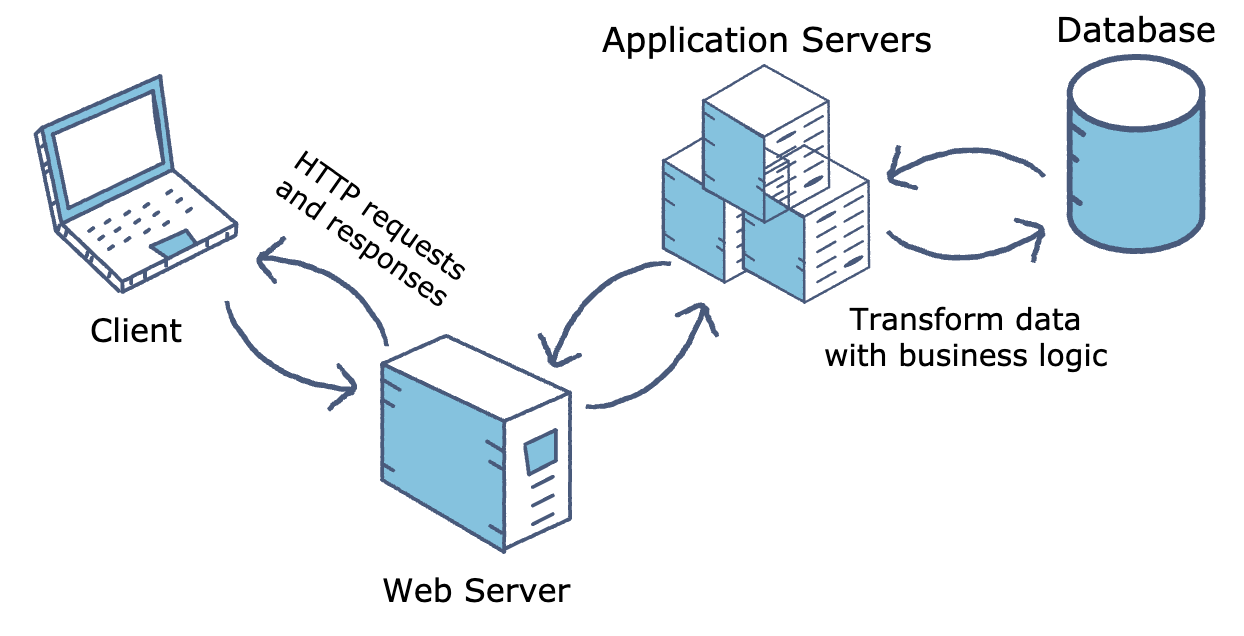
Vector databases enable efficient similarity search across high-dimensional embeddings in RAG pipelines.
Popular Vector Database Options
The vector database landscape offers diverse solutions, each optimized for different use cases and deployment scenarios:
Managed Services for Rapid Deployment:
- Pinecone: A fully managed, serverless option ideal for teams prioritizing rapid development, offering hybrid search and real-time indexing starting at $50/month
- Weaviate: An AI-native database with built-in vectorization modules and advanced hybrid search capabilities, supporting multimodal data with cloud plans from $25/month
- Qdrant: A Rust-based solution known for high performance and advanced filtering, particularly for real-time embedding search, with plans starting at $0.014/month
Open-Source and Hybrid Options:
- Chroma: A Python-native option best suited for prototyping and local development, though not yet production-ready as of late 2025 due to limitations in horizontal scaling and access control
- Milvus: An enterprise-grade solution designed for high scalability and high-throughput serving, often used for large-scale RAG deployments
- pgvector: A PostgreSQL extension that adds vector capabilities to existing databases, leveraging SQL and ACID compliance
💡 Tip: For startups, a common progression is Chroma for prototyping, Pinecone for MVP deployment, then scaling to Weaviate or Qdrant for production workloads.
Key Features to Evaluate
When selecting a vector database, prioritize these critical capabilities:
Scalability and Performance:Solutions like Pinecone, Weaviate, and Milvus handle billions of vectors, while Chroma is limited to millions. HNSW indexing algorithms typically provide sub-100ms retrieval at scale. Databases like Qdrant (Rust-based) and Redis (in-memory) are particularly noted for their speed.
Advanced Search Capabilities:
- Hybrid Search: Combines traditional keyword search with vector search for more robust retrieval, with Weaviate, Elasticsearch, and MongoDB offering strong capabilities
- Filtering: Qdrant offers advanced pre-filtering, while MongoDB supports rich JSON filtering for refining queries based on metadata
- Real-time Indexing: Pinecone and Redis support real-time updates, crucial for dynamic datasets
Indexing Algorithms Explained
The indexing algorithm determines your database's speed-accuracy trade-off:
Algorithm | Best For | Accuracy | Speed | Memory Usage |
|---|---|---|---|---|
HNSW | Production workloads | 90-95% | Sub-100ms | High (in-memory) |
IVF | Very large datasets | Good | Moderate | Lower (disk-based) |
FLAT | <100K vectors | 100% | Slower at scale | Moderate |
HNSW (Hierarchical Navigable Small World): This graph-based algorithm creates a multi-layered index structure offering fast queries with high accuracy (90-95%), enabling sub-100ms retrieval at scale. However, DML operations (insert, update, delete) are often not allowed after index creation, making it best for read-heavy workloads.
IVF (Inverted File): Partitions data points into clusters and builds indexes on disk (cached in memory), making it more memory-efficient than HNSW and suitable for very large datasets.
⚠️ Warning: HNSW memory consumption can be estimated as 1.3 × vectors × dimensions × dimension type size. Plan accordingly for large-scale deployments.
Managed vs Self-Hosted Decisions
Managed services like Pinecone and Zilliz Cloud offer ease of use and reduced operational overhead, handling scaling and maintenance automatically. Zilliz Cloud claims potential cost savings of up to 50x for RAG costs through tailored optimizations.
Self-hosted solutions like Weaviate, Qdrant, and Milvus provide greater control and potentially lower costs for predictable workloads, but require more in-house expertise for setup and maintenance.
Cost Optimization Strategies
Pricing varies significantly, from free tiers and open-source extensions to subscription-based models ranging from $25/month (Weaviate cloud) to $95/month (Elasticsearch cloud).
Key cost-saving approaches:
- Auto-scaling: Pay only for resources actually used during demand spikes
- Algorithm optimization: Use IVF for memory efficiency or enable quantization in Qdrant to reduce costs
- Distributed indexing: For datasets over 10 million documents, choose databases supporting distributed querying to avoid performance bottlenecks
The vector database market is experiencing explosive growth, projected to expand from $1.73 billion in 2024 to $10.6 billion by 2032, reflecting the critical role these systems play in modern AI applications. As you design your RAG pipeline, carefully evaluate your specific requirements for scale, performance, and budget to select the optimal vector database solution.
Building Your First RAG Pipeline
Building a RAG pipeline from scratch may seem daunting, but with the right frameworks and a systematic approach, you can have a working system up and running quickly. This hands-on guide walks you through each essential step, from setting up your environment to validating your final implementation.
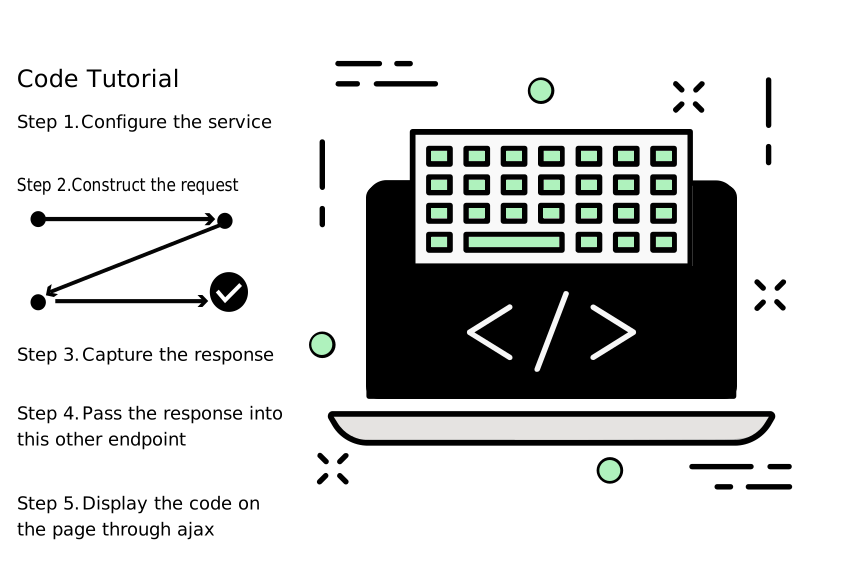
Step-by-step implementation guide for building your first RAG pipeline.
Setting Up Your Development Environment
Before diving into code, you'll need to choose a RAG framework that provides the modular components necessary for pipeline construction. The three most prominent frameworks are LangChain, LlamaIndex, and Haystack, each offering distinct advantages. LlamaIndex is retrieval-first and excels at indexing and information retrieval, while LangChain is orchestration-first, offering a modular framework for complex workflows.
For beginners, Haystack provides an intuitive Pipeline object that simplifies component management and connection. Install your chosen framework along with dependencies for your selected vector database (as discussed in the previous section) and embedding model.
Loading and Preprocessing Documents
The RAG pipeline begins with an "Ingest" or "Indexing" phase where you load and prepare your source documents. This critical stage involves:
- Document Loading: Import files from various sources (PDFs, text files, web pages)
- Chunking: Split documents into smaller, manageable pieces that fit within embedding model constraints
- Metadata Extraction: Capture permission information and other metadata crucial for auditable and grounded answers
For multimodal RAG applications, you'll need specific converters for different file types, such as PDF converters and image converters. The quality of this preprocessing stage directly impacts downstream performance, so invest time in creating clean, well-structured chunks.
Generating and Storing Embeddings
Once your documents are chunked, transform them into numerical vector representations that capture semantic meaning. This embedding process is part of the offline indexing workflow, and your choice of embedding model significantly impacts retrieval quality.
After generating embeddings, store them in your chosen vector database. Here's a simplified example using Haystack's indexing pipeline:
indexing_pipeline.add_component("pdf_converter", PDFConverter())
indexing_pipeline.add_component("pdf_splitter", DocumentSplitter())
indexing_pipeline.add_component("text_doc_embedder", TextEmbedder())
indexing_pipeline.add_component("document_writer", DocumentWriter())
Tip: Implement zero-downtime reindexing strategies to update your vector database without disrupting production systems.
Implementing Retrieval and Generation
The retrieval mechanism finds relevant documents by embedding the user's query and performing vector search against indexed document embeddings. Consider implementing hybrid search that combines vector and keyword approaches for improved accuracy.
The augmentation stage involves building the prompt with retrieved documents and the user query, which the LLM then uses to generate contextually grounded responses. A basic query pipeline structure:
query_pipeline.add_component("text_embedder", TextEmbedder())
query_pipeline.add_component("retriever", Retriever())
query_pipeline.add_component("chat_prompt_builder", PromptBuilder())
query_pipeline.add_component("llm", LLMGenerator())
Testing and Validation
Rigorous evaluation of RAG pipelines is crucial given the numerous decisions involved in text splitting, chunk size, embedding models, and LLM selection. Move beyond ad-hoc testing by implementing automated evaluation processes that assess:
- Retrieval Relevance: Are the right documents being retrieved?
- Answer Quality: Does the generated response accurately address the query?
- Edge Cases: RAG pipelines often struggle with questions combining multiple queries or questions without answers in the corpus
Note: Start with a small, well-curated dataset for initial testing before scaling to production volumes.
Accelerating Development with Pre-Built Solutions
Rather than building everything from scratch, leverage existing resources. NVIDIA offers an accelerated RAG pipeline in their GenerativeAIExamples GitHub repository, providing production-ready code you can adapt to your needs. These examples demonstrate best practices for component integration and error handling, significantly reducing development time.
With these foundational steps complete, you'll have a working RAG pipeline ready for refinement and optimization based on your specific use case requirements.
Advanced RAG Pipeline Techniques
Now that you've built your first RAG pipeline, it's time to explore advanced techniques that can dramatically improve performance, accuracy, and efficiency. These strategies address common challenges like retrieval precision, token management, and complex query handling that basic implementations often struggle with.
Advanced optimization techniques enhance RAG pipeline performance across retrieval, ranking, and generation stages.
Hybrid Search: The Best of Both Worlds
Hybrid search combines keyword (sparse) and semantic (dense) search methods to capture both exact matches and contextual understanding. While semantic search excels at understanding intent and paraphrasing, keyword search remains unbeatable for specific identifiers like product codes, legal citations, or proper nouns. This dual-path approach improves retrieval accuracy by ensuring no useful information is overlooked, making it particularly valuable for technical documents, healthcare records, and legal research where both precision and context matter.
Re-Ranking for Maximum Relevance
After initial retrieval, re-ranking uses advanced models like cross-encoders to re-evaluate and reorder documents based on semantic relevance. This post-retrieval step analyzes query-document pairs individually, assigning new scores that prioritize the most pertinent information. Re-ranking is crucial for managing limited LLM context windows, as it minimizes low-relevance content and ensures your language model receives only the highest-quality context for generation.
💡 Pro Tip: Many modern RAG toolkits offer out-of-the-box reranking capabilities that can be combined with recency bias for time-aware weighting.
Query Expansion and Multi-Query Strategies
Query expansion rewrites a single query into multiple related queries to improve recall, particularly when user inputs are vague or poorly formed. For example, expanding "global warming" might include searches for "climate change" and "greenhouse effect." LLMs can generate these expanded queries, offering a more sophisticated approach than traditional synonym-based methods.
Multi-query retrieval takes this further by generating multiple distinct queries that capture different facets of user intent, then aggregating results to ensure comprehensive information retrieval.
Contextual Compression and Token Optimization
Contextual compression selects only the most relevant parts of retrieved documents to fit within LLM context windows. When a chunk is relevant but too long, compression techniques summarize it without losing critical details or citations. This reduces token usage, lowers costs, and can improve response quality by eliminating noise.
Parent-Child Document Architecture
The Parent-Child Architecture structures documents hierarchically, with parent documents containing child documents. When integrated with hybrid retrieval and contextual compression, this approach has demonstrated significant improvements in Context Precision, Context Recall, and BLEU scores compared to basic RAG implementations. This method is particularly effective for complex documents like technical manuals or legal contracts where context hierarchy matters.
Self-Querying and Metadata Filtering
Self-querying enables dynamic query generation and filtering based on metadata, allowing for temporal filtering, source authority weighting, and domain-specific constraints. This refines search results before LLM processing, ensuring retrieved context meets specific criteria beyond simple relevance—such as recency, credibility, or compliance requirements.
Agentic RAG: The Next Frontier
Agentic RAG represents the evolution toward autonomous systems that incorporate reasoning capabilities and tool use. Rather than simple retrieval-generation loops, these systems can break down complex queries, plan multi-step processes, and utilize external tools like APIs or databases. This approach enables RAG pipelines to handle sophisticated workflows that require decision-making and dynamic information gathering.
⚠️ Implementation Note: Production-ready advanced RAG requires careful evaluation of each technique's impact on your specific use case. Not every strategy will benefit every application—continuous testing and monitoring are essential for optimal performance.
RAG Pipeline Optimization and Performance
Building on the advanced techniques covered earlier, optimizing your RAG pipeline requires a systematic approach to measuring, monitoring, and improving performance across multiple dimensions. While implementing sophisticated retrieval strategies is important, understanding how to evaluate and fine-tune your pipeline determines whether it delivers production-grade results or falls short of user expectations.
Measuring RAG Pipeline Performance
Effective RAG optimization begins with comprehensive performance measurement across three critical dimensions: relevance, latency, and cost. Concrete metrics include retrieval recall@k, LLM hallucination rate, p95 latency, cost per query (aggregating embedding, LLM, and infrastructure costs), and user feedback scores on answer helpfulness.
However, raw metrics don't tell the complete story. High recall@3 might coexist with user complaints about irrelevant answers, indicating potential issues with chunking strategies. This disconnect highlights why building user confidence through source metadata and LLM citation is vital, especially in regulated industries.

A comprehensive dashboard tracking key RAG performance indicators across relevance, latency, and cost dimensions.
Essential Evaluation Metrics
RAG evaluation requires both order-unaware and order-aware metrics to capture different aspects of retrieval quality. Binary, order-unaware measures like HitRate@k, Precision@k, Recall@k, and F1@k provide information on whether relevant documents are present in the retrieved set.
For deeper insights, order-aware metrics prove invaluable:
- Mean Reciprocal Rank (MRR): Measures how high the first truly relevant result appears in the ranking, ranging from 0 to 1, with higher scores indicating better performance. This metric is particularly useful in fast-paced environments where quick decision-making is critical and a single relevant result at the top is sufficient.
- Average Precision (AP): Considers the precision at each position where a relevant document appears, providing a more nuanced view of ranking quality.
- Normalized Discounted Cumulative Gain (NDCG): Accounts for graded relevance, recognizing that some documents are more relevant than others rather than treating relevance as binary.
Optimizing Retrieval Parameters
Fine-tuning retrieval parameters significantly impacts both accuracy and efficiency. The quality of retrieval directly impacts downstream stages, and issues here can propagate invisibly, making this optimization critical.
Top-k Selection: Experiment with different values to balance comprehensiveness and noise. Too few results miss relevant context; too many introduce irrelevant information and increase latency.
Similarity Thresholds: Establish minimum similarity scores to filter out low-quality matches. Dynamic thresholds that adapt based on query characteristics often outperform static values.
Hybrid Search Tuning: When combining vector and keyword search, adjust the weighting between semantic and lexical matching based on your specific use case and content characteristics.
Reducing Latency Through Technical Optimization
Reducing latency is a primary goal for optimizing RAG pipelines, aiming to decrease end-to-end response times from seconds to milliseconds. Multiple strategies work in concert:
- Caching: Cache responses for frequently asked questions to avoid repeated model inference
- Indexing: Approximate Nearest Neighbor (ANN) methods are a key strategy for high-speed AI retrieval
- Infrastructure: Colocating services (vector DB and RAG application servers in the same region) and employing LLM warmup and streaming techniques can significantly mitigate latency
- Query Processing: Batching similar queries and employing parallel processing are effective in managing both average and tail latencies
Balancing Accuracy vs. Speed Trade-offs
Every optimization decision involves trade-offs. The core challenge lies in ensuring that speed optimizations do not compromise the accuracy or relevance of the generated responses. For example, aggressive chunking strategies that are too broad might bury important details, impacting user satisfaction even if recall@3 scores remain high.
💡 Tip: Start with accuracy-focused configurations, then incrementally introduce speed optimizations while monitoring quality metrics. This approach prevents premature optimization that sacrifices user experience.
A/B Testing Pipeline Configurations
The goal of optimization is to tackle improvements one by one, measuring gains as you go. Implement systematic A/B testing to compare:
- Different embedding models or chunk sizes
- Retrieval strategies (pure vector vs. hybrid)
- Re-ranking algorithms and thresholds
- Generation model parameters and prompts
Track both quantitative metrics (latency, cost) and qualitative feedback (user satisfaction, answer quality) to make informed decisions about which configurations to deploy.
Monitoring and Observability Best Practices
Effective monitoring and observability are critical for RAG systems, enabling teams to identify potential issues and iterate faster. This involves implementing RAG-specific metrics such as retrieval accuracy, generation quality, and end-to-end response relevance.
Component-Level Tracing: Break down the performance and behavior of each pipeline stage (retrieval, context integration, generation) to pinpoint bottlenecks and quality issues.
Proactive Alerting: Setting up alerts on key metrics allows AI teams to proactively address issues and monitor system performance effectively. Monitor for anomalies in latency spikes, retrieval quality degradation, or cost overruns.
Cost Optimization Strategies
Cost optimization for RAG pipelines involves managing several components, including compute resources, network transfer fees, and scaling demands. Cloud servers are essential for running embedding engines, vector databases, and query processing modules, with costs varying based on scale and task complexity.
Infrastructure Optimization:
- Auto-scaling for variable traffic, dedicated instances for steady traffic
- Caching responses to reduce repeated inference
- Limiting the number of retrieved chunks
Retrieval Efficiency: Employing hybrid retrieval methods (e.g., keyword matching to pre-filter data) reduces expensive vector operations for queries that can be handled with simpler techniques.
📊 Cost Insight: Managed services can help reduce overhead by handling scaling and maintenance complexities, though they may cost more per unit than self-managed infrastructure.
By systematically applying these optimization strategies and continuously measuring their impact, you can build RAG pipelines that deliver exceptional performance while maintaining cost-efficiency and accuracy.
Common RAG Pipeline Challenges and Solutions
Building on the optimization strategies discussed earlier, even well-tuned RAG pipelines encounter persistent challenges that require targeted troubleshooting approaches. Understanding these common pitfalls and their solutions is essential for maintaining production-ready systems.

Systematic troubleshooting is essential for identifying and resolving RAG pipeline issues.
Handling Irrelevant or Low-Quality Retrievals
Irrelevant or low-quality retrievals often stem from issues in the pre-retrieval, retrieval, or post-retrieval stages. To address this, implement pre-retrieval optimization through enhanced data granularity, optimized index structures, and metadata enrichment. Post-retrieval techniques like re-ranking help prioritize relevant context, while prompt compression reduces extraneous details that introduce noise. Additionally, query rewriting, expansion, and decomposition help align user intent with stored information.
Managing Context Window Limitations
LLMs have finite context windows, necessitating careful management to ensure optimal prompt construction. Implement a context window manager that reserves tokens for the LLM's response and allocates the remaining budget to system prompts, user queries, conversation history, and retrieved chunks. Prioritize inclusion based on relevance and recency, and leverage prompt compression to strip irrelevant sentences from otherwise valuable chunks.
Keeping Indexes Fresh with Document Updates
Managing document updates requires sophisticated strategies beyond simple re-embedding. Real-world systems combine versioning, metadata, lazy updates, and semantic checks. Consider these approaches:
- Selective Re-Embedding: Detect changed sections and re-embed only modified chunks to minimize costs
- Document Versioning: Keep old vectors while indexing new versions marked by doc_id and version numbers for auditability
- Append-Only Indexes: Filter with metadata like is_latest=true rather than deleting vectors, which is safer at enterprise scale
- Lazy Re-Embedding: Re-embed only when a document is queried for significant cost savings
Use content hashing (e.g., SHA-256) to identify actual document changes and avoid unnecessary re-processing.
Addressing Embedding Model Limitations
If working with a specialized domain, fine-tuning the embedding model may be necessary to ensure user queries are correctly understood. Models like BGE-large-EN offer fine-tuning capabilities to optimize retrieval relevance. Additionally, experiment with different chunking strategies, as models like sentence transformers perform better on single sentences, while others like text-embedding-ada-002 are more effective with larger blocks (256 or 512 tokens).
Scaling for Production Workloads
Scaling RAG pipelines involves managing both the data pipeline (offline ingestion, indexing) and the query pipeline (online retrieval, generation). The data pipeline can tolerate minutes to hours of latency, while query pipelines require millisecond to second response times. The "Append-Only Index + Metadata Filters" approach, where vectors are never deleted, is preferred at scale because vector deletes can be expensive and unsafe, particularly in legal, finance, and compliance sectors.
Security and Privacy Safeguards
Security controls are necessary for grounded and auditable RAG answers. Implement access controls at the document level, ensure retrieved content respects user permissions, and maintain audit trails of what information was accessed. The append-only index strategy is particularly valuable in domains with high security and privacy needs like healthcare and finance.
Debugging and Testing Approaches
Production-ready RAG pipelines require careful consideration of evaluation and deployment practices. Implement retrieval verification to validate that the correct documents are being surfaced. Limited explainability in RAG systems necessitates debugging strategies to understand retrieval reasoning. Create test suites with known query-answer pairs, monitor retrieval quality metrics continuously, and establish feedback loops to identify degradation in system performance.
💡 Pro Tip: Quality issues at the indexing stage, such as poor chunking or stale documents, can propagate downstream invisibly. Regular audits of your data pipeline prevent these silent failures.
RAG Pipeline Tools and Frameworks
After addressing the challenges of building robust RAG systems, selecting the right tools and frameworks becomes crucial for efficient implementation. The RAG ecosystem has matured significantly, offering developers a range of options from comprehensive orchestration platforms to specialized retrieval frameworks.

Modern RAG frameworks provide modular architectures for building production-grade retrieval systems.
Leading Framework Options
LangChain stands out as a versatile, modular platform supporting numerous LLM use cases, particularly excelling in multi-step workflows. This orchestration-first framework offers chains, agents, memory, and tool calling, making it ideal when your application needs to browse external sources, call APIs, or perform complex reasoning across multiple hops. While LangChain exposes many choices upfront, including vector stores, retrievers, and memory types, this flexibility comes with increased configuration responsibility.
LlamaIndex takes a different approach, focusing specifically on streamlined search and retrieval with document ingestion and flexible indexes. This retrieval-first platform is optimized for speed and precision with advanced search algorithms, making it particularly effective for enterprise knowledge management systems and internal reference applications. LlamaIndex provides sensible defaults that work out of the box, resulting in faster time to deployment for straightforward RAG implementations.
Haystack, developed by Deepset, offers a pipeline-centric, modular architecture where components act as nodes in a directed acyclic graph. This enterprise-ready framework includes built-in support for evaluation, monitoring, and scalability, with dedicated integration for frameworks like RAGAS and DeepEval. Haystack provides out-of-the-box support for advanced techniques like HyDE and query expansion, though it comes with a steeper learning curve compared to lighter alternatives.
Semantic Kernel, Microsoft's SDK for AI orchestration, enables seamless integration of RAG capabilities into AI agents, particularly for teams already invested in the Microsoft ecosystem.
Framework Selection Criteria
💡 Tip: Choose LlamaIndex for straightforward retrieval applications, LangChain for complex multi-step workflows with external tool integration, and Haystack for production-grade enterprise deployments requiring robust monitoring.
The decision between frameworks depends on your specific requirements. LlamaIndex excels in document ingestion and fast query-time routing, while LangChain is better suited for multi-step flows and complex reasoning. Haystack's modular architecture makes it suitable for complex, multi-stage AI applications where component swapping and debugging are priorities.
Custom vs. Framework-Based Approaches
Many teams start with open-source tools for early development flexibility and then transition to managed solutions for simplified scaling. While frameworks like LangChain and LlamaIndex provide core RAG primitives, production deployments often benefit from orchestrators such as Kestra, Airflow, or Prefect for managing data ingestion and indexing workflows.
Cloud Integration and Deployment
Modern RAG frameworks integrate seamlessly with major cloud platforms, though managed services may constrain deployment flexibility compared to self-hosted solutions. The trend toward managed vector databases and LLM APIs reflects the operational complexity of maintaining these systems at scale.
Open-Source vs. Commercial Solutions
The RAG landscape offers both open-source and commercial options. Haystack provides both an open-source framework and optional deepset Cloud/Enterprise offering for managed hosting, while LangChain and LlamaIndex remain primarily open-source. Teams often begin with open-source tools for flexibility before transitioning to managed services to reduce operational overhead, particularly for vector storage and LLM APIs.
Key Takeaways:
- LangChain: Best for complex orchestration and multi-step workflows
- LlamaIndex: Optimized for retrieval-focused applications with minimal setup
- Haystack: Enterprise-grade with strong evaluation and monitoring capabilities
- Hybrid approach: Combine open-source frameworks with managed cloud services for optimal scalability
Production RAG Pipeline Best Practices
Deploying RAG pipelines in production demands a fundamentally different approach than proof-of-concept development. While the frameworks covered in the previous section provide the building blocks, production environments require robust infrastructure, comprehensive monitoring, and security measures that protect sensitive data while maintaining performance at scale.
Infrastructure and Deployment Considerations
Horizontal scaling can be achieved by running multiple RAG service replicas behind a load balancer, typically managed through containerization and Kubernetes orchestration. A distributed or replicated vector database is essential for shared access and to support scaling and concurrent access, ensuring your retrieval layer can handle production traffic volumes.
Kubernetes orchestration is recommended for deploying RAG as pods with defined resource limits, autoscaling capabilities, and robust health checks. This approach allows your pipeline to automatically scale based on demand while maintaining reliability through health monitoring. For high-volume scenarios, asynchronous processing using message queues and worker pools can handle high query volumes by decoupling request handling from retrieval and generation.
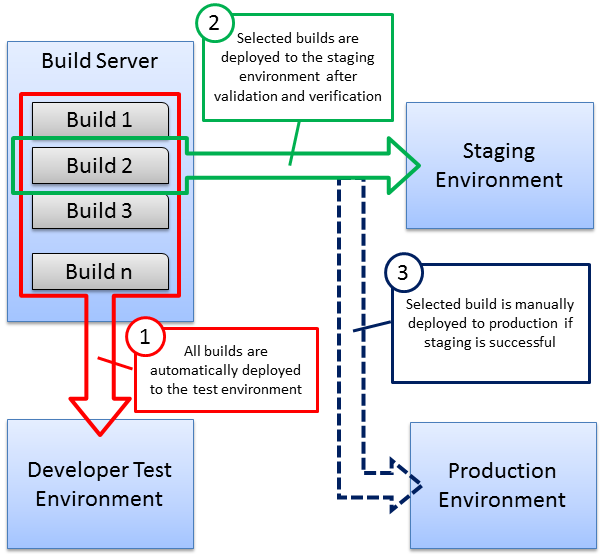
Application lifecycle management from development to production environments.
Performance optimization strategies:
- Colocate services in the same region to minimize network latency
- Cache query embeddings, retrieved documents, and LLM answers to speed up repeated queries and reduce compute costs
- Use model serving platforms like Seldon Core or KServe for deploying and scaling embedding and language models
Monitoring and Alerting
Comprehensive observability separates production-ready systems from experimental ones. Track RAG-specific metrics such as retrieval accuracy, generation quality, and end-to-end response relevance, with component-level tracing to break down the performance and behavior of each pipeline component.
Critical metrics to monitor:
- Retrieval latency (including search and embedding API response times), query volume and distribution, and retrieval accuracy
- Latency and throughput for each stage (embedding, retrieval, LLM generation) to identify issues like index problems or LLM struggles
- Content drift, where knowledge base content or user query patterns evolve, requiring tracking metrics like relevance over time
LangChain's LangSmith can be used to log queries, retrieved chunks, and final answers for detailed analysis, providing the visibility needed to diagnose issues and optimize performance continuously.
Security and Access Control
Security in production RAG systems extends far beyond traditional application security. Leading enterprises are adopting retrieval-native access control, ensuring every document, embedding, and context window adheres to strict authorization and compliance rules.
⚠️ Critical Security Practice: Preserve permission metadata from the system of record and apply deterministic filters at retrieval time so that only authorized chunks are returned
Essential security measures:
- Treat retrieved text as untrusted input and clearly delimit it to mitigate prompt injection risks
- Redact or tokenize PII during ingestion before embedding, as embedded values are difficult to block downstream
- Ensure auditability through traceability of retrieved chunk IDs for each response, review hooks for low-confidence answers, and isolation of tenants and environments
- Implement filtering mechanisms in the ingestion pipeline to mitigate risks like invisible content injection
Version Control and Continuous Improvement
Implementing versioning for code, models, and the knowledge base is crucial for ensuring reproducibility in a RAG pipeline. This includes maintaining version history for embeddings and indexes, enabling rollback capabilities when issues arise.
RAG pipelines are living systems that require ongoing care; documents change, regulations evolve, and user behavior shifts. Re-ingest and re-embed changed documents through scheduled jobs using an incremental approach to reduce costs and ensure users access the latest information. Refine chunking and retrieval settings based on analysis of user feedback and traced issues to improve answer accuracy over time.
💡 Pro Tip: Implement rate limiting and traffic management at the API layer to prevent system overload and control operational costs effectively.
Documentation and knowledge sharing remain critical for team effectiveness, particularly as RAG technology evolves rapidly. Maintain comprehensive documentation of your pipeline architecture, configuration decisions, and operational procedures to ensure team members can effectively troubleshoot issues and implement improvements.
Frequently Asked Questions About RAG Pipelines
As RAG technology matures, teams implementing these systems encounter common challenges and questions. Drawing on the production best practices covered earlier, this FAQ addresses the most critical concerns about RAG pipeline deployment, costs, and optimization.
What is the difference between RAG and fine-tuning?
RAG prevents LLM errors by retrieving relevant information from external datasets to optimize outputs, while fine-tuning addresses response generation issues like incorrect tone, inconsistent citation formats, or non-compliant safety disclaimers.
RAG uses "prompt stuffing" to prioritize retrieved context over pre-existing training knowledge, making it ideal for knowledge that changes frequently. However, LLMs can still misinterpret context even with accurate sources.
Fine-tuning trains models on specific behaviors using techniques like Low-Rank Adaptation (LoRA), particularly valuable in high-stakes fields like healthcare or finance. Domain-specific fine-tuning through continued pre-training on specialized text can lead to superior performance compared to base models.
💡 Tip: Use RAG for dynamic knowledge bases and fine-tuning for consistent response formatting and domain-specific language patterns.
How much does it cost to run a RAG pipeline?
Monthly RAG infrastructure costs typically range from $350 to $2,850 for production systems, with key cost drivers including:
- Vector Database: $70-$500/month depending on scale
- LLM API Calls: $200-$2,000/month at ~$3-15 per million tokens
- Embedding APIs: $10-$50 initial indexing, $5-$20 ongoing
- Document Processing: $20-$100/month
- Hosting/Compute: $50-$200/month
Development time for a competent engineer is typically 2-4 weeks, with ongoing maintenance requiring 5-10 hours per month. Managed services like Zilliz Cloud can reduce overhead by handling scaling and maintenance automatically.
What chunk size should I use for my documents?
Chunk sizes are typically chosen between 200 and 500 tokens, balancing retrieval precision with contextual coherence. Smaller chunks offer more precise retrieval, while larger chunks retain more context.
Best practices for chunking:
- Use semantic boundaries: Respect paragraph breaks and section headers rather than fixed-length splitting
- Implement overlap: Prevent important sentences from being split across boundaries
- Consider document structure: Tables, lists, and code blocks may require different handling than prose
- Balance model constraints: Account for context windows and token pricing
Adaptive chunking that moves beyond fixed-length can improve retrieval precision and recall by providing more coherent context. Frameworks like LangChain and LlamaIndex simplify experimentation with different strategies.
Can RAG work with real-time data?
Yes, RAG pipelines can work with real-time data through event-driven architectures powered by tools like Apache Kafka. Change Data Capture (CDC) with filtering rules ensures only meaningful updates flow through the system, preventing pipeline overload.
For example, Spotify uses CDC to stream only significant updates like new song releases, keeping the system lean and fast while maintaining data freshness.
How do I handle multiple data sources in a RAG pipeline?
RAG pipelines can search various collections including PDFs, Notion pages, and web articles, with the generative model guided to cite sources appropriately. Robust data pipelines are essential for keeping RAG systems in sync with constantly changing sources.
Key considerations include maintaining consistent embedding strategies across sources, implementing source-specific metadata tagging, and establishing clear data refresh schedules for each source type.
What are the latency expectations for RAG systems?
Latency requirements differ significantly between pipeline types:
- Data Pipeline (Offline): Minutes to hours are acceptable for scheduled ingestion, chunking, and indexing
- Query Pipeline (Online): Milliseconds to seconds required for user-facing retrieval and generation
Achieving low latency in query pipelines often necessitates performance-optimized compute units, which can increase infrastructure costs. Workflow orchestrators like Kestra or Airflow handle offline tasks, while frameworks like LangChain manage online queries.
How do I evaluate RAG pipeline quality?
LLM-judged relevance provides a low-effort evaluation method requiring only test queries rather than full labeled answers. GPT-4 achieves near-human performance for chunk-level relevance assessment, making it ideal for rapid experimentation.
Evaluation approaches:
- Rapid experiments: Compare vector databases or retrieval setups without manual re-labeling
- Production monitoring: Apply evaluations to live traffic to identify knowledge base gaps
- Quality checks: Implement nightly checks on retrieval behavior
⚠️ Warning: Highly specialized domains (legal, medical, technical) may require domain experts for accurate relevance judgments.
Can RAG pipelines work offline?
RAG data pipelines are designed for offline, batch, or scheduled operations, handling ingestion, chunking, embedding, and indexing independently of user queries. The query pipeline operates online but relies on the pre-built index created by the offline data pipeline.
This architecture means RAG systems can function with a pre-built index even without continuous real-time connectivity for data ingestion, making them suitable for environments with intermittent connectivity or strict data isolation requirements.
Getting Started with RAG Pipelines

Your RAG pipeline journey begins with understanding the fundamentals and taking the first step.
You've explored the essential components of RAG pipelines—from ingestion and indexing to retrieval and generation. These systems bridge the gap between unstructured data sources and Large Language Models, enabling factual, domain-specific responses without costly retraining. Now it's time to put this knowledge into action.
Your Learning Path Forward
Start with the basics and build progressively. Beginner-focused series guide you through constructing RAG pipelines from scratch, helping you achieve solid understanding before tackling advanced configurations. Focus on mastering each stage—Ingest, Index, Retrieve, Rank, Augment, and Respond—before moving to the next.
Begin with simple use cases. Treat your RAG pipeline as a production system from day one, focusing on orchestration and observability rather than viewing it as a mere demo. This mindset shift ensures your foundation supports future scaling.
Resources and Community Support
Leverage tutorials on frameworks like Haystack and LangChain for production-ready implementations. Platforms like Kestra offer orchestration layers and Slack community channels where you can connect with practitioners facing similar challenges.
The Future of RAG
Exciting developments are emerging: graph-powered retrieval using knowledge graphs, hierarchical chunking approaches like RAPTOR, and adaptive multimodal systems integrating text, images, and video. Modular RAG frameworks with independent, reconfigurable components are making systems more flexible and powerful.
Experiment and Iterate
The RAG landscape evolves rapidly, requiring continuous evaluation and flexibility. Don't aim for perfection on your first attempt. Build, test, measure, and refine. Each iteration brings you closer to a robust, production-ready system that delivers accurate, contextual responses.
Your RAG journey starts now, embrace experimentation, learn from the community, and build something remarkable.